Few universities have played such a formative role for film and television in higher education as the University of Iowa.
Iowa has been on the front lines of nearly every major development in the field: from the first studies of cinema-going to the rise of university film and television production to the formation of academic film studies as we know it today. Iowa had a hand in creating both of our major disciplinary bodies (UFVA and SCMS) and functioned as a Midwest center for educational film production for much of the 20th century.
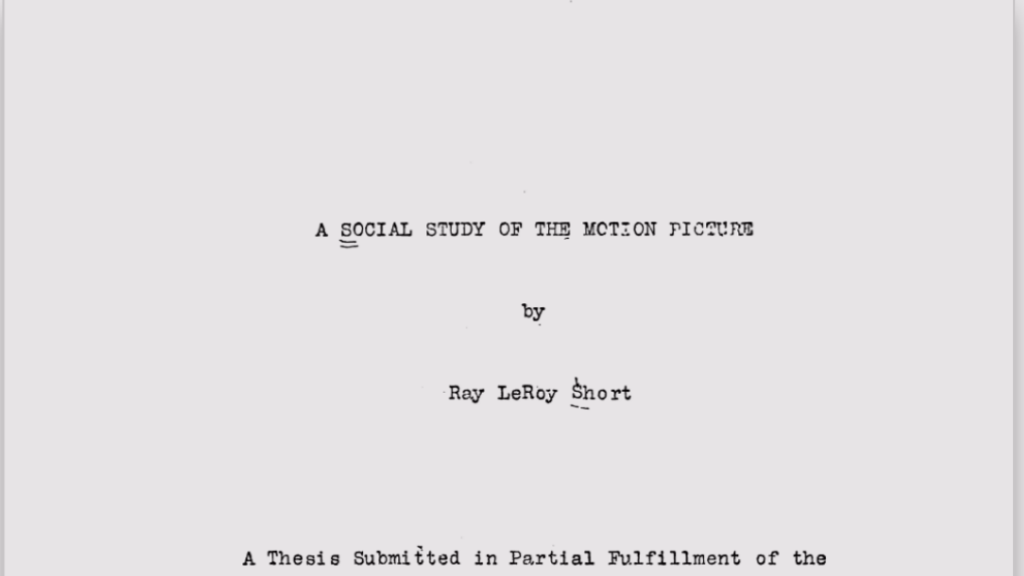
First Academic Thesis on Motion Pictures in the English Language
1910sIn 1916, with movie-going exploding across the country and debates about the impact of movies on society heating up, the Department of Political Economy and Sociology at the State University of Iowa approved the first academic thesis on film in the English language: A Social Study of the Motion Picture by Ray Leroy Short. Short's thesis coincided with other early academic work on film, such as The Photoplay by the Harvard-based experimental psychologist Hugo Münsterberg (also published in 1916). One can find a few examples of contemporaneous doctoral work happening in other countries, such as Emilie Altenloh's dissertation On the Sociology of Cinema, completed in Heidelberg in 1914, but Short's thesis was the first of its kind in the United States.

Pioneering Educational Film
1920sAt the beginning of the 20th century, the State University of Iowa was heavily involved in the movement for Visual Education, and by 1920, the University President, the Director of the Extension Division and the Dean of the Education College all sat on the board of the newly formed Society for Visual Education. Within this context, the university's extension division became a key supplier of educational films to the region. This led to the founding of Department of Visual Instruction (later renamed Bureau of Audio-Visual Instruction) and Motion Picture Production Unit, which produced dozens of educational films for national circulation from the 1930s onward. (You can see a sample film catalogue from the Extension Division here.) Iowa's Motion Picture unit would continued producing educational content well into the 1980s, often with grants from the NEH, such as the 1981 documentary about Grant Wood, Door in Turner Alley.

Iowa Alums Make their Mark in the Film Industry
1930sBeginning in the 1930s, Iowa alumni began making careers in the film and television industries. Most of these early alums came from the Department of Speech and Dramatic Art, which taught drama, public speaking and communications and would soon integrate a major film and tv production sector starting in 1952. Early alums included many actors, such as MacDonald Carey (BA Speech and Dramatic Art 1935), pictured above starring alongside Joseph Cotten and Theresa Wright in Hitchcock's Shadow of a Doubt (1946). But there were also screenwriters, producers, directors, stuntmen and more. By the 1950s, most of these alums (e.g. Gene Wilder, Greg Morris, Nicholas Meyer, Linda Carleson, Mary Beth Hurt) had come through a department that encompassed both drama and film and television production. The Writers' Workshop would also produce several notable screenwriters starting in the 1970s.
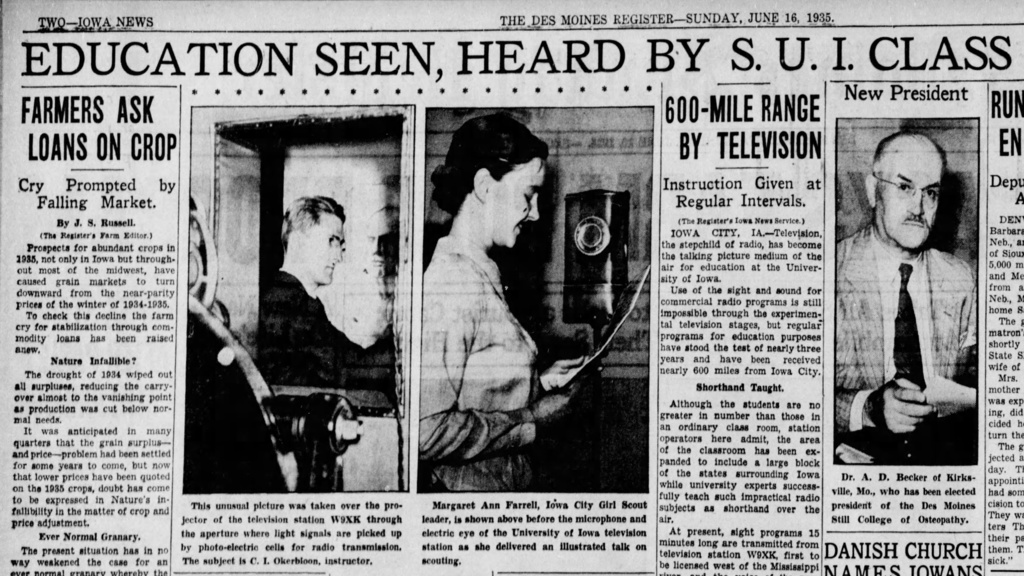
Leading the Way for Experimental Television
1930sIn 1932, the university constructs an experimental television station. The first educational television station in the world, and the first television station anywhere West of the Mississippi, channel W9XK broadcast between 1932 and 1939 using a Nipkow disk system. Weekly broadcasts included lectures on Art, Astronomy and Botany, as well as drawing lessons and student-produced radio plays.
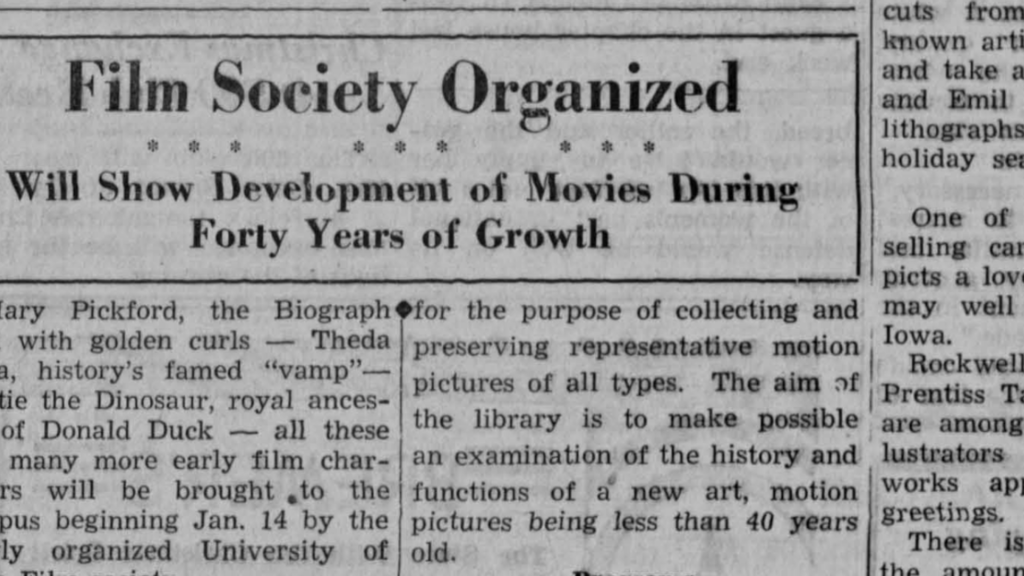
At the Forefront of the Film Society Movement
1940sIn 1940, as the film society movement gained steam in the US, students from the Art Guild in the Department of Fine Art founded the University Film Society, dedicated to studying the history of film as an art form. Throughout the 1940s, the Iowa University Film Society held sold-out screenings and film discussions roughly once a week in the Fine Arts Building and at MacBride Hall. Like other film societies of this period (though founded earlier than most), Iowa's film society drew on the 16mm prints from the MOMA Film Library, founded by Iris Barry in 1935. Titles from the society's initial seasons included The Thief of Bagdad (Raoul Walsh, 1924), Mother (Vsevelod Pudovkin, 1926), Metropolis (Fritz Lang, 1927) and The Plow that Broke the Plains (Pare Lorentz, 1936). Many of these titles would go on to form the early canon of Film Studies, which Iowa helped to invent (see below). In many respects, the Iowa University Film Society was a precursor to the legendary Bijou Film Board, founded in 1972 and still operating today in conjunction with Iowa City's premier art-house cinema, FilmScene.

UFVA Founded in Iowa City
1947In 1947, members of the University Film Producers Council met in Iowa City and founded the University Film Producers Association, better known today as the University Film and Video Association. The new association quickly exploded with participation from departments all around the country. Iowa figures like cinematography instructor John Mercer and Vernon Putnam of the university's Motion Picture Unit were heavily involved in those founding years, and UI faculty would hold positions of president, treasurer, journal editor and more.

Pioneering Film Production as a University Discipline
1950sIn 1952, foreseeing the rapid expansion of television in the post-WW2 era, the University of Iowa founded an academic film and television production program: the Division of Radio, Television and Film. Housed in the Department of Speech and Dramatic Art, the Division served both graduate and undergraduate students. The founding coincided with the construction of advanced film & television studios, which were housed in the famous Old Armory building until the 1980s. During the 50s and 60s, the Division trained numerous television personnel and produced content for film and television across the region. The founding of this division in 1952 made Iowa one of the few universities in the country at the time to offer advanced degrees in Film and TV Production.
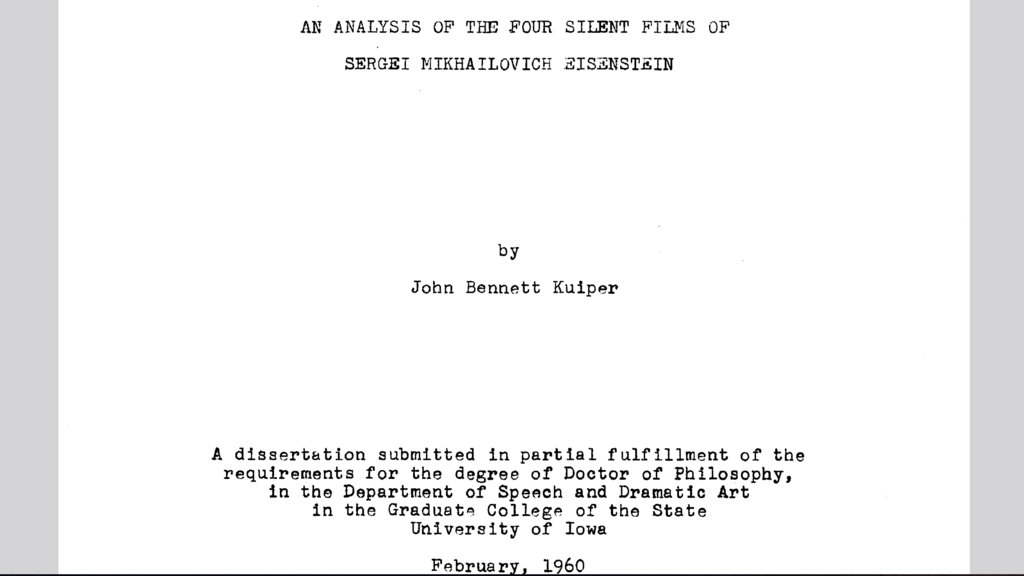
Creating Film Analysis as an Academic Pursuit
1960sIn 1957, film production student John Bennett Kuiper drew on the aesthetic impetus of the film society movement to craft an MA thesis titled Pictorial Composition in the Cinema, followed in 1960 by his PhD dissertation: An Analysis of Four Silent Films of Sergei Mikhailovich Eisenstein. With their focus on the aesthetic analysis, these graduate projects served as pioneering models for what would later become known as "Film Studies." Graduate students in RTF would produce further dissertations on film aesthetics through the 1960s, focusing on filmmakers such as Harold Lloyd and Ingmar Bergman; film theorists including Vachel Lindsay and Hugo Münsterberg; and movements such as German Expressionism.

Future SCMS Holds Conference in Iowa City
1964In 1964, the Society of Cinematologists, familiar today as the SCMS (Society for Film and Media Studies), held its fifth annual conference in Iowa City. This was the first conference ever in the Midwest. John Kuiper, who had become an Assistant Professor for Film at Iowa, organized and hosted the two-day event, which included various papers; roundtable discussions of research, archives and copyright; a screening of new UI acquisitions from the MOMA circulating collection; a dinner at the Amana Colonies, and a closing reception at the Kuipers' residence. Kuiper went on to become president of the Society of Cinematologists in 1966, followed by a distinguished career as Head of the Motion Picture collections at the Library of Congress and Director of Film Collections at the George Eastman House. Iowa would retain a central place in the SCMS with four presidents coming from our faculty and alumni (John Kuiper, Raymond Fielding, Patrice Petro and Barbara Klinger), as well as several career achievement winners. A second conference SCMS conference was held in Iowa in 1989.
Inventing the Field of Film Studies in the US
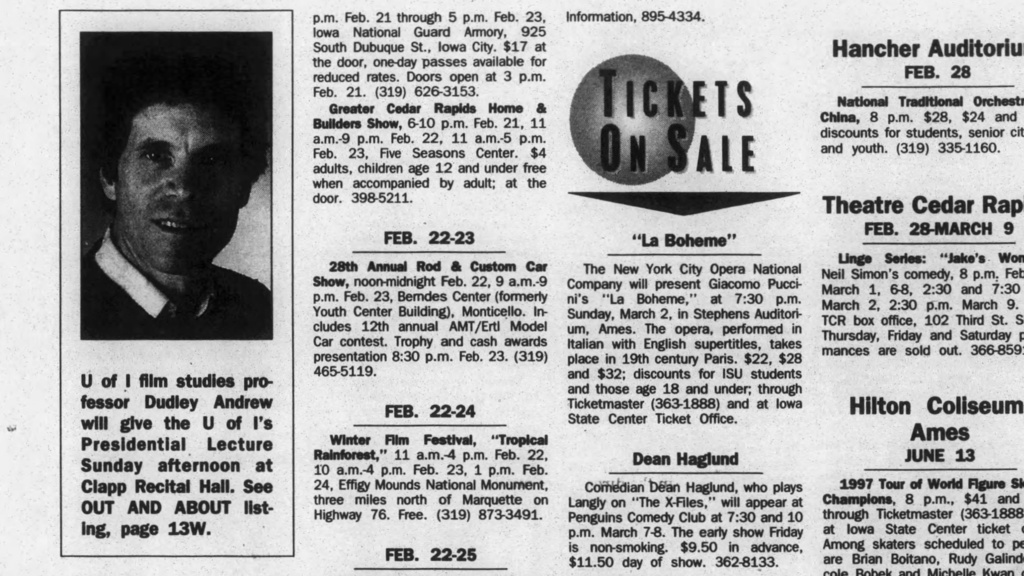
1970sIn 1971, having just completed his dissertation in the English Department on film theorist André Bazin, Dudley Andrew is hired as an instructor of film aesthetics in the Department of Speech and Dramatic Arts. This marks the beginning of a phase of intense disciplinary formation, in which Iowa shapes the field of Film Studies as we know it. Under faculty such as Andrew, Rick Altman and Lauren Rabinovitz, a legion of field-defining scholars come through our graduate program, including David Bordwell, Mary Ann Doane, Aaron Gerow, Henry Jenkins, Barbara Klinger, Patrice Petro, David Rodowick, Thomas Schatz, and more, with visitors including the likes of Thomas Elsaesser and the legendary theorist Christian Metz. Many of these faculty and students now grace the list of Career Achievement award winners at the Society of Cinema and Media Studies. At the same time, Iowa strengthened its reputation as a center for experimental filmmaking under the leadership of Franklin Miller.
Communications and Broadcast Era
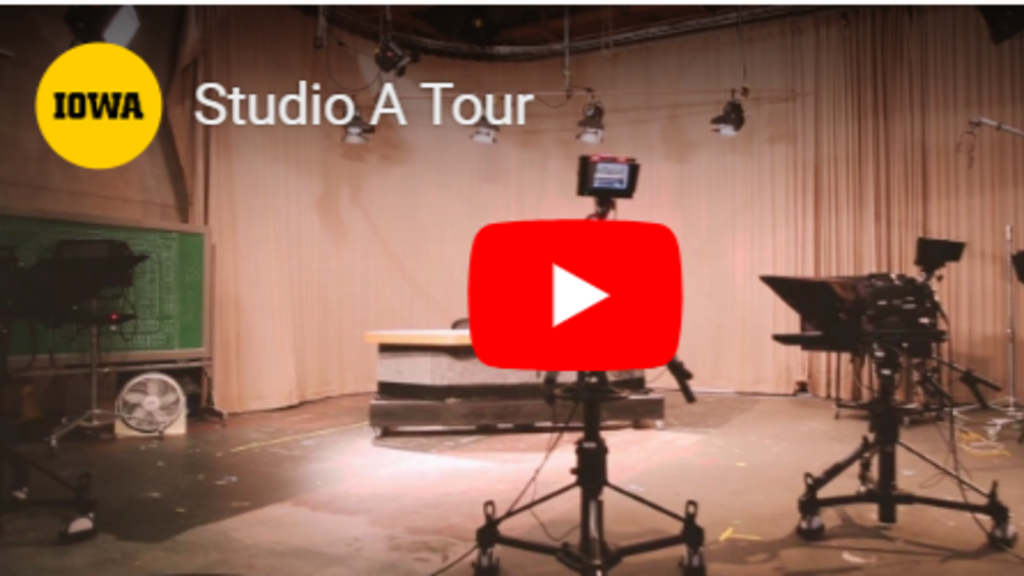
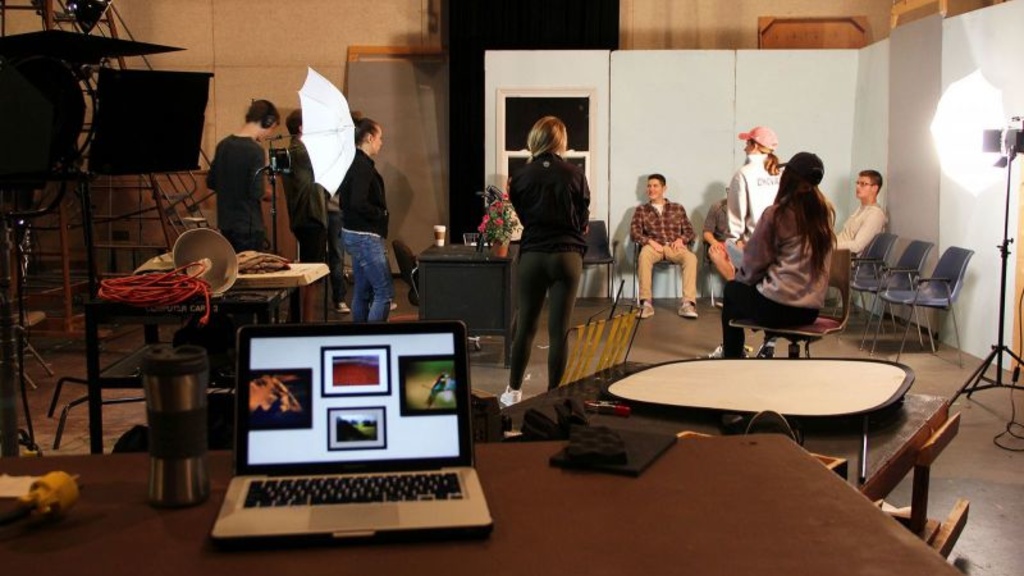
1980s-90sIn the early 1980s, the Department of Communication Studies splits off from Theater, taking cinema with it. The new department also acquires a new building on the site of the old Armory in 1985 (known today as the Becker Communication Studies Building or BCSB), replete with three new film & tv studios. Those studios—Studios A, B and C—are still used by students in Film and Video Production today. Many cinema graduates from this period would populate the world of Broadcast TV and advertising.
Cinema Becomes an Independent Department
2000-presentIn 2002, Cinema joined the Department of Comparative Literature before becoming an independent unit—the Department of Cinematic Arts—in 2014. The new department, now one of the five core units in the visual and performing arts, has grown quickly over the past decade, reaching over 500 majors and minors today. It continues to be a national leader in Film Studies and Film Production, which mutually inform the work of students in our Cinema BA. Faculty in Cinematic Arts have won numerous awards and shown their work in venues from Cannes to the Whitney Museum and beyond.
Screenwriting at the Heart of the Writing University
2020sIn 2019, the university regents approved a new BA program in Screenwriting Arts, housed in Cinematic Arts alongside the BA in Cinema. Having just celebrated its 5th anniversary, Screenwriting is now one of the fastest-growing programs at the university and a rising powerhouse within Iowa City's already legendary creative writing scene. Screenwriting students at Iowa have the unique advantage of residing between top-notch university programs in both creative writing and cinema, and there is never a shortage of major literary events to attend.
Looking to the Future
With the integration of Screenwriting, the Department of Cinematic Arts now offers a comprehensive education in film arts to rival that of larger, privately funded, film schools. Our graduate and undergraduate students enjoy a range of degree pathways (in production, screenwriting, history and theory) that is still rare among our Big-10 peer institutions. We also collaborate closely other units in arts, writing and communications and share a long list of high-profile alumni in the film & TV industries. Students in Cinematic Arts have won academy awards, shown in festivals such as Cannes, and gone on to do pioneering work in both film studies and film production. We seek to continue empowering our current students to become the distinguished alumni of the tomorrow.
We're also keenly aware that we remain the only public university film school in Iowa, and we strive to serve the students of this state and beyond with a world-class film education. For over a century, Iowa has led the way for film & television in American higher education, and student demand for advanced university training in these areas has never been higher than today.
Select graduate projects and students in Film & Television Studies at the University of Iowa (1916-2020)
- Ray Leroy Short, A Social Study of the Motion Picture (1916)
- Perry Holaday, The Effect of Motion Pictures on the Intellectual Content of Children (1930)
- Gerold Holstine, A Direct Observation of Certain Principles of Teaching: A Sound Motion Picture Film (1942)
- Max Turner, State Regulation of the Motion Picture Industry (1947)
- Kim Griffin, The Role of Leadership in Four Network and Television Discussion Programs (1950)
- Murray Jaeger, An Analysis of Edward R. Murro's 'See it Now' Television Program (1956)
- John Kuiper, An Analysis of Four Silent Films of Sergei Mikhailovich Eisenstein (1960)
- Richard Byrne, German Cinematic Expressionism, 1919-1924 (1962)
- William McCaffrey, An Investigation of Three Feature-Length Silent Film Comedies Starring Harold Lloyd (1962)
- Orazio Fumagalli, The Television Medium and Television Programs on Art (1963)
- Joseph Wolfe, Vachel Lindsay: The Poet as Film Theorist (1964)
- Robert Snyder, A History of the Early Productions of Pare Lorentz and the United States Film Service 1935-1940 (1965)
- Peter Dart, Pudovkin's Film Theory (1965)
- Edward Perry, A Contextual Analysis of Michaelangelo Antonioni's film 'L'Eclisse' (1968)
- Donald Crafton, MA in Film Studies (1970)
- Christian Koch, Understanding Film as Process of Change: A Metalanguage for the Study of Film Developed and Applied to Ingmar Bergman's 'Persona' and Alan J. Pakula's 'The Sterile Cuckoo' (1970)
- Mark Flanders, Film Theory of James Agee (1971)
- Dudley Andrew, Realism and Reality in Cinema: The Film Theory of André Bazin and its Source in Recent French Thought (1972)
- Timothy Lyons, The Silent Partner: The History of the American Film Manufacturing Company (1972)
- Calvin Pryluck, Sources of Meaning in Motion Pictures and Television (1973)
- Kristin Thompson, MA in Film Studies (1973)
- Donald Fredericksen, The Aesthetic of Isolation in Film Theory: Hugo Münsterberg (1973)
- David Bordwell, French Impressionist Cinema: Film Culture, Film Theory, Film Style (1974)
- Kathryn Kane, A Critical Analysis of the WWII Combat Films, 1942-45 (1976)
- Thomas Schatz, Hollywood Film Genre as Ritual: A Theoretical and Methodological Inquiry (1976)
- Paul Seydor, Sam Pekinpah: The American Aspect. A Study of his First Five Films (1976)
- Philip Rosen, The Concept of Ideology and Contemporary Film Criticism: A Study of the Position of the Journal 'Screen' in the Context of the Marxist Theoretical Condition, Volumes 1 & 2 (1978)
- Mary Anne Doane, The Dialogic Text: Film Irony and the Spectator (1979)
- Brian Lewis, Jean Mitry and Problems in Film Theory (1980)
- Miriam (Mimi) White, An Extra Body of Reference: History in Cinematic Narrative (1981)
- David Rodowick, The Political Avant-Garde: Modernism and Epistemology in Post-'68 Film Theory (1983)
- Pamela Falkenberg, Rewriting the 'Classic Hollywood Cinema': Textual Analysis, Ironic Distance and the Western in the Critique of Corporate Capitalism (1983)
- Thomas Doherty, Teenagers and Teenpicks, 1955-1960: The Juvenilization of American Movies (1984)
- Marcia Butzel, Movement as Cinematic Narration: The Concept and Practice of Choreography in Film (1985)
- Henry Jenkins, MA in Communications/Film Studies (1985)
- Angela Dalle Vacche, From the Statuesque to the Protean:The National Body in Italian Cinema (1934-1982) (1985)
- Barbara Klinger, Cinema and Social Process: A Contextual Theory of Cinema and its Spectators (1986)
- Patrice Petro, Joyless Streets: Women and Melodramatic Representation in Weimar Germany (1987)
- Caryl Flinn, Film Music and Hollywood's Promise of Utopia in Film Noir and the Woman's Film (1988)
- Kelly Conway, MA in Film Studies (1988)
- James Lastra, Standards and Practices: Technology and Representation in American Cinema (1992)
- Charles O'Brien, Cinema and Historical Culture of the Third French Republic (1992)
- Claire Fox, The New Border Establishing Shots: Aesthetics and Politics in the Era of North American Free Trade (1995)
- Sarah Projansky, Working on Feminism: Film and Television Rape Narratives and Post-Feminist Culture (1995)
- Jeffrey Ruoff, Family Programming, Television and American Culture: A Case Study of An American Family (1995)
- Aaron Gerow, Writing a Pure Cinema: Articulations of Early Japanese Film (1996)
- Scott Curtis, LIke a Hailstorm on the Nerves of Modern Man: Cinema, Legibility and the Body in Germany, 1895-1915 (1996)
- Ernesto Acevedo Muñoz, Deconstructing Nationalism: Luis Bunuel and the Crisis of Mexican National Cinema, 1946-1955 (1998)
- Rosanna Maule, The Practice of Embalming Cinema: Film Authorship in Contemporary France, Italy and Spain (2000)
- Christian Keathley, The Wind in the Trees: Cinephilia, Panoramic Perception and History (2000)
- Mitsuyo Wada-Marciano, The Production of Modernity in Japanese Cinema: Shochiku Kamata Style in the Late 1920s and 1930s (2000)
- Aaron Han June Magnan Park, Cinescapes of the Yet-To-Be-Fully-National Hong Kong Action Cinema's Transnational Engagement (2002)
- Jamie Baron, MA in Film Studies (2005)
- Jennifer Wilde, L'Imagination cinémentale: The Cinematic Impression on the Avant-Garde in France 1913-1929 (2006)
- Ofer Eliaz, Cinematic Cryptonomies: Figurations of the Unseen Image (2008)
- Swarnavel Pillai, Tamil Cinema and the Major Madras Studios (2010)
- Michael Slowik, Hollywood Film Music in the Early Sound Era, 1926-1934 (2012)
- Erica Stein, An Island off the Coast of America: New York City Symphonies as Productions of Space and Narrative (2013)
- Linda Mokdad, Imaginary Geography: Mapping the History of the Middle East in Post-9/11 American Cinema (2013)
- Dimitrios Latsis, Nature's Nation on the Move: The American Landscape Between Art and Cinema, 1867-1939 (2015)
- Kim Se Young, Crisis in Neoliberal Asia: Violence in Contemporary Korean and Japanese Cinema (2016)
- Leah Vonderheide, Inner Lives: The Moral Cinema of Bresson, Rohmer and the Dardennes (2017)
- Chang-Min Yu, Corporeal Modernism: Transnational Body Cinema Since 1968 (2019)
"The faculty and students at Iowa helped me to make the transition from someone with a passion for film but little knowledge of film theory into someone who could hold his own at some of the top film programs in the country and helped to lay the foundations for my career down to the present day."